Transcript of A Journey of Transition: Carolyne's Story - Part One
When I began this Podcast, the first episode took several months to research before I was ready to record it, and the next few appeared somewhat erratically, but now I am pleased to say new episodes appear every three weeks, well, fingers crossed.
I also feared that I would soon run out of topics, well as this episode marks going into double figures the apprehension I had, was it seems unfounded, and to mark this event I thought I would discuss my transition Journey.
I mentioned my idea for episode ten to a really good friend of mine, and she asked, “would I be able to include all that I wanted to say in one episode”, and thinking about it she was right.
I am not sure if this will be the first two or a trilogy, what I know for sure is this episode will end with me leaving school, and as for the structure, I feel it would be suited to a series of vignettes, interspersed with contextual historical events.
Welcome to “Trans Wise Trans Strong”, I am Carolyne O’Reilly.
Episode ten, “A Journey of Transition: Carolyne’s Story - Part One”
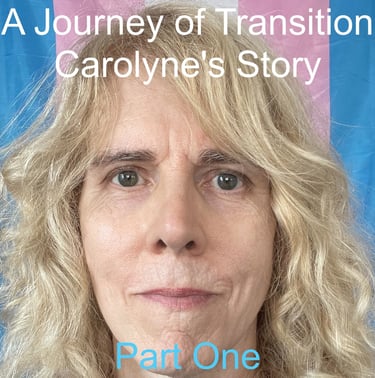
When thinking about this episode I wasn’t sure how open I could be, but after some thought I decided on total honesty, even if that means detailing private truths, and as for the image for the episode, well it wasn’t a hard decision to make, hence the selfie, so now you can put a face to my name.
Although if you had already googled Carolyne O’Reilly, you may have come across a
BBC blog called Get In blog where I described joining the BBC and coming out as trans woman, complete with five year old selfie.
A question that I suspect most if not all trans and non-binary people will have encountered at one time or another is, “when did you know you were trans or non-binary?”, and it is a very good question.
I would suggest a factor in answering is when you where born, as wider understanding and acceptance of being trans or non-binary has at times resembled a roller-coaster ride, which currently feels like we are heading to a nadir, but hopefully it wont be for long before we end the ride on a positive plateau.
But first lets look at a few trans pioneers, starting in the thirties with Lili Ilse Elvenes, who, although her gender affirming surgery was publicised at the time in the Danish and German press, was not widely known about, until the book and film, “The Danish Girl”, which portrayed her life, although with questionable accuracy.
Then in the fifties there was Christine Jorgensen, whose gender affirming surgery widely publicised, acceptance and understanding was sadly lacking, as was the experience of April Ashley who in 1960, had her surgery in Casablanca, Morocco.
April’s successful career as a fashion model was greatly impacted by being outed by “The Sunday People” newspaper in 1961, a callous act that another trans pioneer would later experience.
I was born in the early sixties, and general awareness of trans people in this new decade had still not greatly increased over the previous ones, and similarly understanding not much improved either.
Therefore I grew up feeling different but not knowing why, and it is only in retrospect, that I can understand that at various points through my life there where obvious indications of my true female gender, also it wasn’t until my mid fifties that I found out I had OCD and was on the autistic spectrum.
It wasn’t until my mid teens that I seriously started to question that the sex I was assigned at birth did not necessarily reflect my gender identity, but I am getting ahead of myself, so where to begin?
Why not when it all began, my birth, at the end of 1962, and for younger listeners and my wonderful loyal listeners outside of the UK, that winter was something special, it was bloody freezing and was called, with perhaps not much imagination, “The Big Freeze”.
Snow began falling on Christmas Eve across Scotland and moved south blanketing the whole of the UK, and lasted until March 1963.
So when it was time for me to go home from the hospital it posed a problem, my mother told me that back then hospitals had matrons, a sort of head nurse, who was respected and perhaps a little feared, and it was matron who arranged for my mother and me to be transported home.
Apparently the conversation went something like this.
Matron: “I have a young mother and baby who needs to go home”.
“I am fully aware of the snow”.
“No, you will get in your cab and I expect to see you soon”.
Apparently it was not that long before a somewhat meek taxi driver came to take me and my mother home.
Although being trans and not knowing has had an impact throughout my life until I decided to transition, there were a couple of non trans related incidents, whose psychological ramifications I have occasionally wondered at.
The first, well I had this mole, oh dear this is beginning to sound like a Jasper Carrott anecdote, no this mole was ruby red and was in the middle of my back, and I obsessed about it, did I mention my OCD, and one night in bed when I was five I picked at it and it bled, ah that was why it was precious stone coloured.
Where I use to live, in winter was not very warm, and I used to were a vest in bed, my parents like most working class were not that rich, and central heating, well that would have been a luxury, oh no, I now sounding like the “Monty Python” four Yorkshire men sketch, although that actually first appeared in a show in 1967, the “At Last the 1948 Show”.
But back to the mole, as I said it bled and in the morning when I got up I took off my vest and my mother nearly fainted, the back of my vest was coloured a dull red stain, needless to say I was told in no uncertain terms, do not pick at your mole.
Another was when I was six, my uncle was taking a photo of me lying on the floor on my front propping my head up on my hands, when my young cousin came into the room and moved behind half a table tennis board leaning against the wall, and causing it to pivot down onto my head.
My uncle quickly pulled off the board off and ask me to touch my head and he also nearly fainted to see it was cover with blood, my mother took me to the local hospital, were they decided to put in 2 stitches, but first they needed to cut away some hair.
The nurse, I think her name was Ratched, grab a length off my hair practically lifted me of the ground before cutting off a length, funny but I have never like table tennis since.
But the first indication of my trans identity was near the end of the sixties when I was six, when my mother who was a hairdresser, brought home a wig to prepare for a customer, and I put it on.
The word transgender would have been unknown to her, as it would have been for most mothers, let alone what it meant to be transgender, therefore she definitely would not have considered my wearing the wig a demonstration of a feminine trait, she was just concerned I would damage it.
In fact the term transgender had only existed for less than five years, the word transgender was derived from “transgenderism”, coined by the Psychiatrist John F. Oliven, of Columbia University, in their 1965 reference work, “Sexual Hygiene and Pathology”.
Another event, again when I was six, was when I was out shopping in Crisp Street market, and there were two girls who had red eye make-up, and a woman was talking to them about how this wasn’t a good colour choice, and I thought I wish I could wear eye make-up.
There was one last event, which was when we were about to leave infants school, we were in an assembly were the head teacher was talking about our move to junior school, and I was sitting behind a girl and she ask me to plat her hair.
If I had presented as a girl I doubt if any comment would have been made, but as it was, the head teacher did make a comment at my expense, which upon reflection was probably my first, but by know means last, experience of transphobia.
So aged six, I felt different but had no way of knowing why, these days if you have questions and an internet connection, no problem, but in the sixties, no internet, no answers.
Back then Google had a different name, it was called The Library, and had basic search function, which was a wooden cabinet, with draws of small cards, for advance search function there was, the librarian.
So feeling somewhat confused about my gender and wondering why, was a question I could not easily find an answered to, like I was going to ask the librarian, “I think I should have been born a girl”, I don’t think so.
At the end of the sixties there was a court case, Corbet v Corbet, which was the divorce of Arthur Corbet and April Ashley.
The ruling was given in 1970, and Arthur was granted an annulment of the marriage to April on the grounds that April was assigned male at birth, even though she had had gender affirming surgery, and this ruling would have profound ramifications for trans people for over the next forty years.
Another event at the beginning of the seventies was when I did something familiar to cisgender girls, playing with my mothers make-up, later my mother asked if I been playing with her make-up, and already I had an instinct to say no.
I have always wondered what would have happened if I had said yes, but this being the early seventies, I fear the outcome would not have been positive.
The early seventies also saw the rise of glam rock, where performers such as Marc Bolan and David Bowie blurred gender lines, and it was on the 6th of July 1972, on Top Of The Pops that David Bowie performed, “Starman”, with Mick Ronson, and this landmark performance brought Glam Rock into the homes of the nation.
The performance split the nation though, over an action during the song, that today would barely be noticed, David draped his arm around Mick’s shoulder, I know crazy, yet then conservative viewers objected, the young celebrated.
A friend of my mother was chatting to her, whilst this edition of Top Of The Pops was on, and said to me “I should be able to borrow your make-up soon”, and I wanted to say, I wish you could.
Now in Junior School, one time we had lessons in drawing and some of the girls coloured their finger nails with felt tip pens to look like they were wearing nail varnish, oh what innocent times, and yet I wish I could also have done the same.
I would occasionally in secret put on my mothers make-up, it was something I felt I needed to do, and soon the time at Junior school passed and then it was time for secondary school and with that soon came puberty.
I mentioned earlier that another trans pioneer had experienced being outed as a trans woman, and she was Caroline Cossey who had her gender affirming surgery at Charing Cross Hospital, itself a pioneering hospital in gender care, in 1974.
It was during pre-surgery testing that Caroline learnt that she had an Intersex condition, called XXXY syndrome, and if you would like to learn more about Intersex/DSD conditions, might I suggest episode one, “In The Beginning”.
Caroline had had a very successful modelling career under the name, “Tula”, but like April was outed in 1981 by another tabloid newspaper, the “News of the World”, which was a very distressing experience for her, but a year later, she responded by publishing her autobiography, “I Am a Woman”.
If you thought puberty was a confusing time if cisgender, just imagine what it was like being trans, when from my perspective now, that evil sex hormone testosterone was enacting changes on my physiology that would subsequently take years to undo.
At times I wished I had been born female, no that is not exactly accurate, it would be more accurate to say I wished my anatomy had been female, as I now know that psychological I was always female.
Then at other times I wished I didn’t have these feelings of wanting to be female, and these confusing feelings oscillated, not helped by the impact of testosterone on my emotions, and societies expectation that I conform to the sex I was assigned at birth.
Then on the 25th of June 1979, there was an episode of the documentary series, “Inside Story”, which was about another trans pioneer, “Julia Grant” and the start of her transition journey, which was where I finally learnt to a degree about being transgender, except the term used through out was transsexual.
However there was a scene that that had a profound impact on me, it was Julia’s interview with a psychiatrist, who was male and off camera, and in the room there was also another man and a woman.
It last a while, as evidenced by the number of edits, and it felt very confrontation, and not being very confident, it left me with a feeling that I would not have the strength to go through gender transition, a feeling that regretfully lasted for several decades to come.
Sixteen months later this episode would form the first part a three episode series over consecutive nights called very inaccurately, “A Change of Sex”, where we followed Julia’s transition journey, and then there was two further episodes, in August 1994 and August 1999.
It is perhaps worth reiterating that it was psychiatrist that had the power over whether Julia would be able to continue her transition, and it felt like she had to be like a supplicant, to be granted her desire to affirm her gender.
In 2019 aged just 64 Julia died after a short illness.
The dissonance between trans people’s gender identity and their physiology is now understand to be “gender incongruence”, but this has not always been so, initially it was considered a mental illness, then a disorder and finally a condition, with the care, well sort of care, transitioning from psychiatry to psychology.
As for me after my ‘O’ levels, I spent the six or eight weeks before the summer holidays studying for an ‘A’ level in Art, grade D was all I obtained, but still an ‘A’ level, which was better than after two years at ‘A’ level studies, where as far as I can recall, I didn’t pass a single exam.
Then the big wide world beckoned, or more accurately I joined the ranks of the two and half million other Britain’s, who were unemployed.
This episode was written and presented by me, Carolyne O’Reilly, thank you for listening.
Next time, “A Journey of Transition: Carolyne’s Story: Part Two”